Showing posts with label melatonin. Show all posts

Thursday, November 08, 2012

Melatonin Improves Sleep In Patients Taking Beta Blockers

In a pioneering study on the use of melatonin to improve sleep in patients with hypertension who are taking beta blockers, researchers from Brigham and Women's Hospital led by Frank Scheer, PhD, MSc, found that melatonin supplementation can indeed improve sleep patterns in these patients.

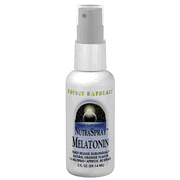
Melatonin sublingual Spray

The study was carried out over the course of three weeks and found that none of the study participants taking the melatonin showed any of the adverse effects that are often observed with other classic sleep medication.
Scheer said that there were also no signs of 'rebound insomnia' after the participants stopped taking the drug and that in fact, melatonin had a positive carry-over effect on sleep even after the participants had stopped taking the drug.


Melatonin is produced in the pineal gland and is a hormone that is closely involved in the sleep wake cycles. It is a naturally occurring compound which is present in plants, microbes, animals, and humans. Levels of melatonin in people are different, depending on the daily cycle. It is also a very powerful antioxidant which protects mitochondrial DNA.

Saturday, October 20, 2012

Do You Need Less Sleep As You Get Older?

The amount of sleep needed as we get older is a controversial subject.

Some say that you do need less sleep as you get older.
The University of Surrey conducted a study where the researchers wer surpised to find that decrease in sleep that comes with advancing years is a normal part of aging.

According to them, this is because aging brings less time spent in deep, slow-wave sleep, the "dead" phase where nothing wakes you. Despite this, the older subjects still displayed less daytime sleepiness than the younger subjects. They say that the fact that older people need less sleep is explained by the fact that they get a better quality of sleep, and the older the brain, the more effectively it cycles through the stages of sleep.

Others disagree and say that getting older can bring real sleep issues to many who slept just fine when younger.
This is due to many reasons:
- hormonal changes after menopause in women
- changes in levels of melatonin
- secreting less growth hormone as we age
- medical issues that cause pain and discomfort
- depression, anxiety and dementia
- side effects of medications

The most important thing is how you feel after a night's sleep. Do you feel rested and refreshed or tired and lethargic? If you are in the latter group, you can try some natural ways to help you sleep better,such as yoga or any other gentle exercise, acupuncture, herbs or supplements and try to spend some time in the sunlight or bright light every day.

Monday, October 15, 2012

Light Pollution Caused By Eco Friendly Street Lighting

Night-time artificial lighting is harmful and causes light pollution...

The International Congress of Zoology discussed "Light Pollution and its Ecophysiological Consequences" and was held at the University of Haifa, Israel.
It discussed exposure to light at night, the extent of the harm and dangers it does and the adverse health effects that follow.
Apparently, it is the short wavelength illumination that we have come to know as 'eco-friendly lighting' that is causing the most harm.

Exposure to light at night affects the circadian rhythms in nature, of humans, animals and plants, which when thrown off can result in various illnesses and adverse symptoms.

Dr. Franz Hölker of the Leibniz Institute in Germany, said that street lights in populated areas are responsible for 60 percent of the Light pollution at night and this is intensified under cloudy conditions when the light is reflected back down to the ground.

Prof. Haim, a leading authority on light pollution, presented one of his studies showing the adverse effects of exposure to light at night on rats.
The study showed that light exposure at night, particularly short wave blue LED, caused varying levels of damage to their metabolic rates, hormone production, body mass, and oxygen consumption, as well as suppressed levels of melatonin production, which is responsible for tumor growth.
He postulated that he would expect to find similar results of damage from human exposure to LED lighting, as the youth in the West are typically surrounded by this sort of lighting in the guise of TVs, computer screens and smartphones in their bedrooms.
Tuesday, May 27, 2008

Insomnia and The Menopause

Insomnia can be a real plague during the menopause, because this is precisely when you need the healing and uplifting power of sleep the most.

There are many remedies that can be of help in helping you sleep, including Valerian, Melatonin and even Homeopathy.

Try the different options and see what suits you best. Valerian is the most popular one and works very well on most.
The usual dose is 150 to 500mg of a standardised valerian extract about half an hour before bedtime.

Whatever you do, try not to get into the habit of taking prescription sedatives!